Why AI Training Fails (And How to Make It Work)
You hired a trainer. Everyone sat in the room. Three months later? Nobody uses it.
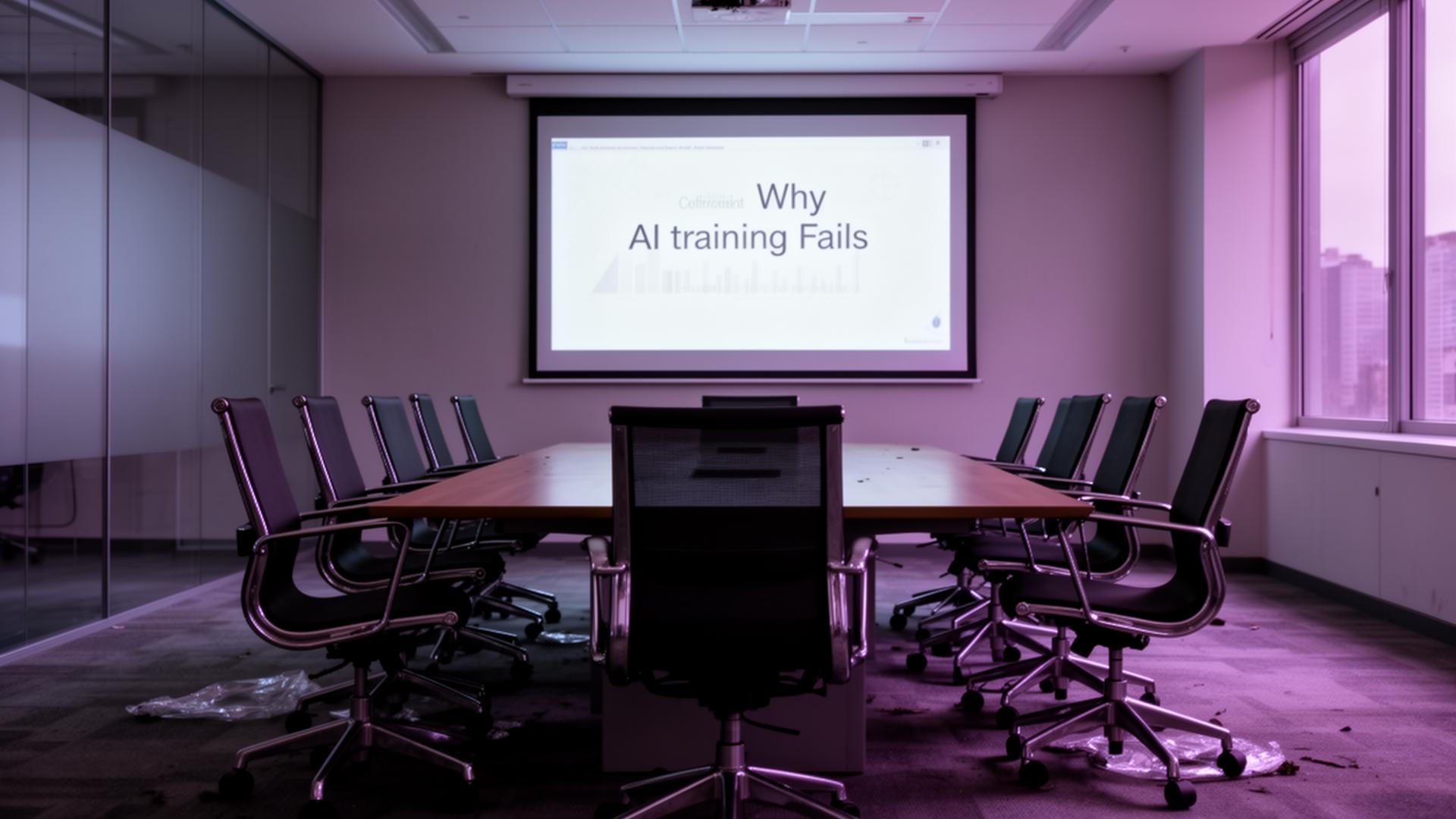
The Recognizable Tragedy
You know the scenario:
Monday morning. Big office. The trainer stands in front of 30 people. PowerPoint on. "Today we learn AI!"
The trainer explains what machine learning is. How neural networks work. What prompt engineering is. Interesting for some. Overwhelming for most.
Friday: everyone goes home. "What an educational week!"
Three weeks later: you walk past a colleague who says: "How was that AI training anyway? You did start experimenting, right?"
"Uh... yes, once. But actually I just go back to how I always did it."
And there it ends. Training millions down the drain.
This doesn't just happen with AI. But with AI it's extra bad, because:
- It feels more complicated than it is
- People are afraid it threatens their job
- You can't learn it "passively" – you have to play with it
Why Classic AI Training Fails
Mistake 1: Too Theoretical
Trainers want to give you the foundation. So they talk about algorithms, data science, machine learning... and you're sitting there as a marketer thinking: "What am I going to do with this?"
You don't need to understand how Claude/ChatGPT works. You need to understand: how do I help my team use this tool.
Mistake 2: One-size-fits-all
You put the developer next to the HR manager next to the accountant in the same training. The developer: way too basic. The HR manager: way too technical. Nobody is satisfied.
Good training: adapt to roles and levels.
Mistake 3: One-off Event
One training, one day or week, done. But learning is iterative. You try something, fail, try differently, succeed.
One-time training doesn't work. You need progression.
Mistake 4: No Context
The trainer uses examples from their own world. "Imagine you're a journalist..." You're not a journalist. You're a logistics manager in Amsterdam.
Good training: focused on your work, your processes, your problems.
Mistake 5: Missing Permission to Experiment
Many organizations say: "You can use AI!" But in practice? There's tension of: "Don't tell the boss. Make sure your output is still properly checked. Don't waste company time on experimenting."
So you don't experiment. So you don't really learn.
How AI Training DOES Work
We have different formats that actually work:
Format 1: Inspiration Session (Kickoff)
Goal: Build hype and remove fear.
What: A half-day program. Practical examples. Stories from companies experimenting with it. Writing live prompts with the audience. Aha moments.
After: People go home enthusiastic. They want to experiment.
Format 2: Hands-on Workshop
Goal: Get your hands dirty and do it.
Setup: Small groups (8-10 people). Per role/department.
Result: They go home with real examples they'll use on Monday.
Format 3: Monthly Training (Program)
Goal: Learn by doing over time.
Setup: 4 months, monthly 2-hour sessions + independent work.
This works because you do it together. Mistakes feel less shameful. Successes become celebration.
Format 4: One-on-one Coaching
What: 4-6 sessions. Focused on their role.
A software architect uses AI differently than a content creator. This acknowledges that.
The Key: Permission to Fail
Here's what really matters, and what many trainings miss:
You must give your team permission to experiment.
Say explicitly:
- "It's ok to test prompts and make mistakes"
- "Spend time learning, that's your job"
- "Share your experiments – others can learn from them"
- "We measure adoption, not: make a mistake, get in trouble"
Without permission, nobody experiments. Without experimenting, nobody really learns.
The Hard Truth
AI training is not about technology. It's about trust and mindset.
You can give people the best toolkit in the world. Without permission to play with it, it sits on the shelf.
The best trainings? They say: "This is simple. You can do this. Try it. Fail. Learn. Have fun."
Want your team to grow with AI?
plaiwrks designs training that actually sticks – pragmatic, tailored to your context, and with real experiments. We always start with your role, your context, your fears. Not with theory.
View our training approach →Written by Emma van Leeuwen
Deel dit artikel: